
Adobe Flash: why it died, and how to play Flash games today
Flash ran the web's games, cartoons and video for over 20 years until Adobe ended it in 2020. Its history, why it died, how to play Flash today, and a Flash game made for this post.
For over 20 years, Flash ran a large part of the web. Games, cartoons, adverts, whole websites and YouTube’s videos all played in Flash Player, a browser plug-in that by 2005 was installed on more computers than any other web media format. Adobe ended it on 31 December 2020, and from 12 January 2021 Flash Player refused to play anything at all. This post covers where Flash came from, why it died and how you can still play Flash games and cartoons today. It also has a Flash game, made for this post, that you can play on this page.
This is the first post in Extinct tech, a Braindumps series about technology that has died out.
Play Keep Flash Alive, a real Flash game
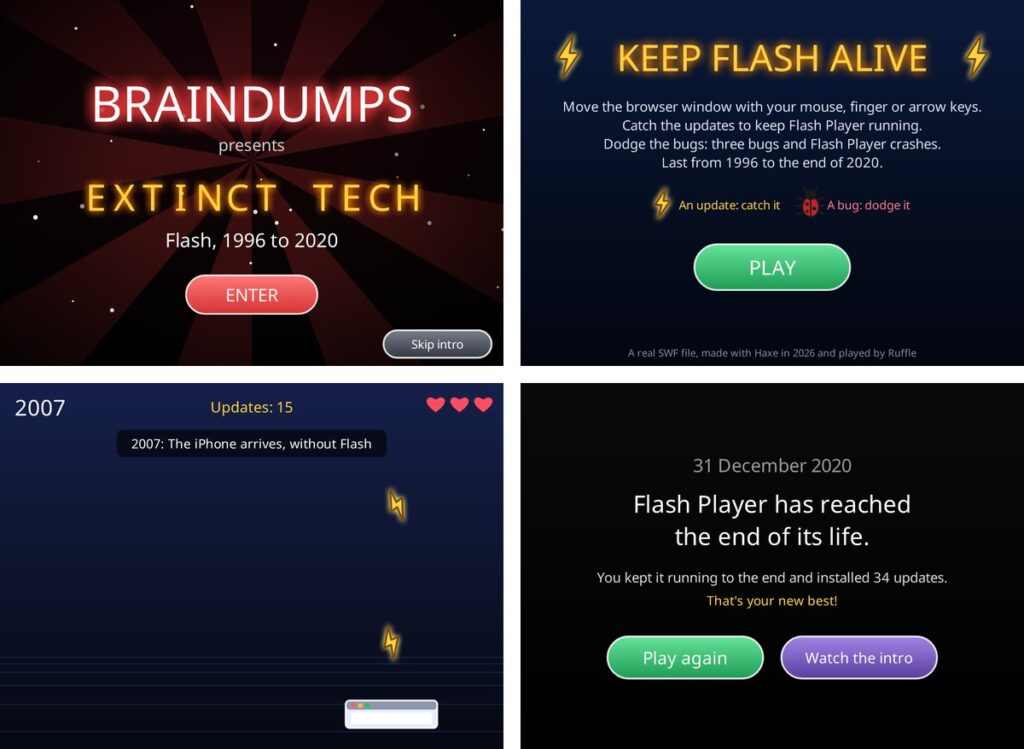
Keep Flash Alive is a real Flash file (a SWF file, the kind Flash Player played), made for this post in November 2026. It starts the way many Flash websites did: a loading bar, an animated intro and a “Skip intro” button. Then you play: move the browser window to catch the updates and dodge the bugs, and keep Flash Player running from 1996 to the end of 2020. The years go by as you play, with real events from Flash’s life along the way.
The Flash game needs JavaScript switched on in your browser.
Flash Player can no longer be installed, so the game is played by Ruffle, a free, open-source Flash Player emulator that runs inside your browser. Your best score is saved the way Flash games saved theirs, in a Flash “local shared object”, which Ruffle keeps in your browser’s storage on this device. If you would rather not load Ruffle, the picture below shows the game.
What Flash was
Flash was two things. Designers used the Flash editor to draw, animate, add sound and write code, and saved the result as a SWF file. Visitors’ browsers played the file in Flash Player, a free plug-in. Flash drew with shapes and lines (vectors) rather than pixels, so its files were small enough for the dial-up modems of the late 1990s, and a Flash file looked and worked the same in every browser that had the plug-in.
From Flash 5 in 2000, Flash had its own programming language, ActionScript, which turned it from an animation tool into a way to make games and applications. Flash Player 6 added video in 2002, and when YouTube launched in 2005 it played its videos through Flash Player. In the UK, BBC iPlayer used Flash to stream programmes when it launched in December 2007. Facebook’s games were built in it too: FarmVille, which launched in June 2009, had about 84 million players a month at its peak in March 2010.
A short history of Flash
- 1993: FutureWave Software, a small company co-founded by Jonathan Gay, releases SmartSketch, a drawing program.
- May 1996: FutureWave releases FutureSplash Animator, an animation program for the web.
- December 1996: Macromedia buys FutureWave and renames the program Macromedia Flash.
- 2000: Flash 5 brings ActionScript, Flash’s own programming language.
- 2002: Flash Player 6 adds video.
- 2005: YouTube launches, playing its videos in Flash. In December, Adobe completes its purchase of Macromedia, and Flash becomes an Adobe product.
- 2007: The iPhone goes on sale without Flash. No iPhone or iPad ever ran Flash Player.
- June 2009: FarmVille launches on Facebook, built in Flash.
- 29 April 2010: Steve Jobs publishes “Thoughts on Flash”, explaining why Apple will not allow Flash on the iPhone and iPad.
- November 2011: Adobe stops developing Flash Player for mobile browsers.
- January 2015: YouTube makes HTML5 video its default.
- February 2016: Adobe renames its Flash editor Adobe Animate. It can also make HTML5 animation.
- 25 July 2017: Adobe announces that it will end Flash Player at the end of 2020.
- 8 December 2020: The last update, Flash Player 32.0.0.465.
- 31 December 2020: Adobe’s support for Flash Player ends. The original FarmVille closes on Facebook the same day.
- 12 January 2021: Flash Player starts blocking Flash content. Chrome 88 and Firefox 85 remove Flash later that month; Safari 14 had already dropped it in 2020.
Why Flash died
There was no single cause. Several problems arrived together, and the web found other ways to do what Flash did.
- Phones. The iPhone never ran Flash. In “Thoughts on Flash”, Steve Jobs said it used too much battery power, crashed, performed poorly on mobile devices, had security holes, did not work with touch screens and would put another company’s software layer between Apple and app developers. Flash Player did reach Android phones, but in November 2011 Adobe stopped developing it for mobile browsers. As more browsing moved to phones, anything built in Flash could not reach a growing share of visitors.
- Security. Flash Player was one of the most attacked programs on the web. Wikipedia counts more than 1,000 recorded security flaws (CVEs) in it, over 800 of which could let an attacker run their own code on a victim’s computer. Users had to install updates constantly. In July 2015, Firefox blocked Flash Player for a time because of security holes that had not been fixed, and Facebook’s head of security called on Adobe to set an end date for Flash.
- The web caught up. HTML5 gave browsers their own video, drawing (canvas) and animation, with nothing extra to install. YouTube made HTML5 video its default in January 2015, and once video, games and animation all worked without a plug-in, there was little left that needed Flash.
- Adobe moved on too. Adobe renamed its Flash editor Animate in 2016, aimed it at HTML5 as well, and in July 2017 set the end date for Flash Player.
What happened when Flash stopped
Most people did not notice, because almost everything had moved on, but a few organisations had left it late. In January 2021, a railway line in Dalian, China, was reported to have problems with dispatching and ticket systems that still used Flash, until staff got Flash working on the station computers again (officials denied there was a problem). South Africa’s tax authority found that its online tax forms used Flash, and released its own browser with Flash built in, which works only with its website. In mainland China, a Chinese company still distributes its own edition of Flash Player.
How to play Flash games and cartoons today
Adobe’s Flash Player can no longer be downloaded, and you should not install a copy from anywhere else: Adobe asks everyone to uninstall it, its last versions refuse to play anything after 12 January 2021, and older versions have security holes that will never be fixed. These are the safe ways to play Flash today.
- Ruffle in your browser. Ruffle, which plays the game on this page, is a free, open-source Flash Player emulator written in the Rust programming language. It runs inside the browser as WebAssembly, within the browser’s security sandbox. Sites such as Newgrounds, Armor Games, Coolmath Games and the Internet Archive use it to keep their Flash content working. There is also a Ruffle extension for Chrome, Edge, Firefox and Safari, which makes Flash content on other sites play again.
- The Ruffle desktop app plays SWF files on Windows, macOS and Linux. You can try it with the game on this page: use the “Download the .swf file” link under it.
- Flashpoint Archive is a free, non-profit preservation project that has saved more than 200,000 games, animations and other interactive pieces from the web, and plays them in a program on your computer. It began in December 2017.
- The Internet Archive has a large collection of Flash games and animations that play in the browser through Ruffle. It started adding them in November 2020.
Ruffle does not play everything yet. Its own figures (November 2026) say it supports 99% of the ActionScript 1 and 2 language and 82% of its built-in features, used by older Flash content, and 90% of the ActionScript 3 language and 82% of its features, used by most later games. Most games work, but some still have problems.
How we made a Flash game in 2026
You do not need Adobe’s software to make a Flash file. Keep Flash Alive is written in Haxe, a free programming language that can still compile to SWF files. Haxe code looks much like ActionScript 3, the later version of Flash’s own language, and the SWF file it makes holds the same kind of ActionScript 3 bytecode that Flash Player ran. The stage is 550 by 400 pixels, the default size of a new Flash document, and everything is drawn with Flash’s own vector drawing commands, so the whole file is only 12 KB.
It also has some of the things people remember from Flash websites: a loading bar that sticks at 67% for a moment, an intro with a “Skip intro” button, glowing text, and a best score kept in a local shared object, Flash’s own kind of cookie. This part of the code drops the updates and bugs, with more bugs, falling faster, as the years go by:
// Drop updates and bugs: more bugs, and faster, as the years go by.
spawnTimer -= dt;
if (spawnTimer <= 0) {
    spawnTimer = 0.9 - 0.4 * progress + Math.random() * 0.25;
    var isBug = Math.random() < 0.15 + 0.3 * progress;
    var s = isBug ? bug() : bolt(1);
    s.x = 28 + Math.random() * (W - 56);
    s.y = -24;
    scene.addChildAt(s, scene.getChildIndex(paddle));
    items.push({s: s, bug: isBug, vy: 110 + 140 * progress + Math.random() * 40,
        spin: (Math.random() - 0.5) * 120, phase: Math.random() * 6});
}
On this page, the game file is stored inside the page itself, and Ruffle loads it from there. Ruffle comes from jsDelivr, a free network that hosts open-source code, only when you press the button, and your browser checks that Ruffle’s main file is exactly the version this page expects.
Questions people ask
When did Flash stop working?
Adobe ended its support on 31 December 2020, and from 12 January 2021 Flash Player blocked all Flash content. Chrome, Edge, Firefox and Safari no longer support it.
Is it safe to install Flash Player now?
No. Adobe asks everyone to uninstall it, and copies offered on other download sites cannot be trusted. Use Ruffle or Flashpoint Archive instead.
Can I still play old Flash games?
Yes. Many still play on their original sites through Ruffle, the Ruffle browser extension brings back others, and Flashpoint Archive has saved more than 200,000 games, animations and other pieces. Not every game works perfectly yet, especially later ones written in ActionScript 3.
What replaced Flash?
HTML5: the browser’s own video, canvas drawing and CSS animation, with WebGL for 3D, all programmed with JavaScript. None of it needs a plug-in.
Why didn’t the iPhone have Flash?
In “Thoughts on Flash” (April 2010), Steve Jobs said Flash drained batteries, crashed, ran badly on mobile devices, had security holes, did not support touch screens and would put another company’s software layer between Apple and its app developers.
More Extinct tech
Extinct tech is a new series. Later posts will look at other technology that has died out, and they will be listed under the Extinct tech tag. For more old games, see the Retro section, including the Intellivision games list.
Sources
Wikipedia: Adobe Flash; Wikipedia: Adobe Flash Player; Wikipedia: Adobe Animate; Wikipedia: Flash Video; Wikipedia: Thoughts on Flash; Adobe: Flash Player end of life; Wikipedia: FarmVille; Wikipedia: BBC iPlayer; Kaspersky: A world without Adobe Flash; Wikipedia: Ruffle; Ruffle: compatibility; Ruffle: downloads; Flashpoint Archive; Flash 8 Cookbook: setting stage dimensions; Haxe manual: getting started with Haxe/Flash.