
Can you make a good Commodore 64 game with AI?
Can AI help make a Commodore 64 game worth playing? How I built Van Helsing: A Night at Castle Dracula with Claude, automated tests, test players and play-testing.
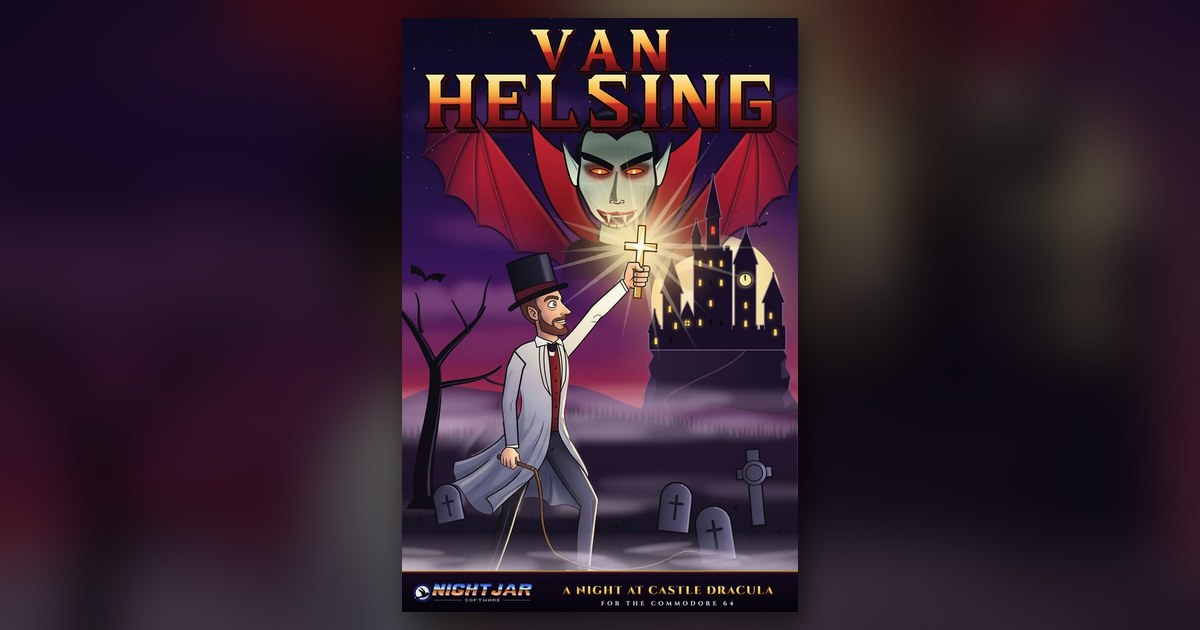
Everyone talks about “AI slop” and “vibe coding”. I wanted to find out whether AI could be used with real programming practice to make a quality Commodore 64 game: proper design, well-structured code, testing, and round after round of play-testing and fixing. The aim was a game that people would enjoy and that I could be proud of and enjoy playing myself.
The result is Van Helsing: A Night at Castle Dracula. You can play it now in the Commodore 64 emulator here on Braindumps: choose Van Helsing from the menu. For my part, I think it can be done. I can complete the game, and even get the special ending if I complete it without continuing (well, only twice). But part of the answer is for you, the readers and players.
Van Helsing: the facts
- Game: Van Helsing: A Night at Castle Dracula, from Nightjar Software, my label
- Machine: Commodore 64 (PAL)
- Formats: disk, tape and EasyFlash cartridge
- Rooms and bosses: 36 rooms in six chapters, and six bosses
- Where to play: in your browser, in the Braindumps C64 emulator (choose Van Helsing from the menu), or download it from itch.io on disk, tape or cartridge: pay what you want, or nothing.
A game I had in my head for a long time
I have quite a lot of programming experience, in modern languages and going all the way back to the early 80s, when I got my first Commodore 64, but I never had the time to fulfil a dream: writing a Commodore 64 game using assembly, a real game that people would want to play. I had the plot of this one in my head for a long time, and I knew what I wanted it to be.
I read Derek Morris’s Retro Game Dev: C64 Edition, volumes 1 and 2, and other books on assembly, and I experimented. I got the hero’s movement how I wanted it, very like Mario in Super Mario Bros. I could write real assembly and get real results. But I was busy, and it was too big a project to finish. I knew that what I had imagined would take a year or two, or more.
As AI advanced, I wanted to see how far it could take me. Before long I realised it could give me the game I had always dreamt of. That turned the real question into this: can you get past AI slop and vibe coding, use real programming practice, and produce a quality game?
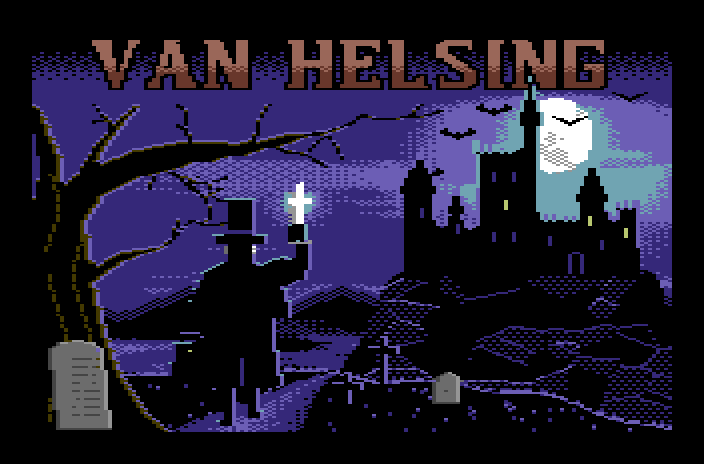
The game
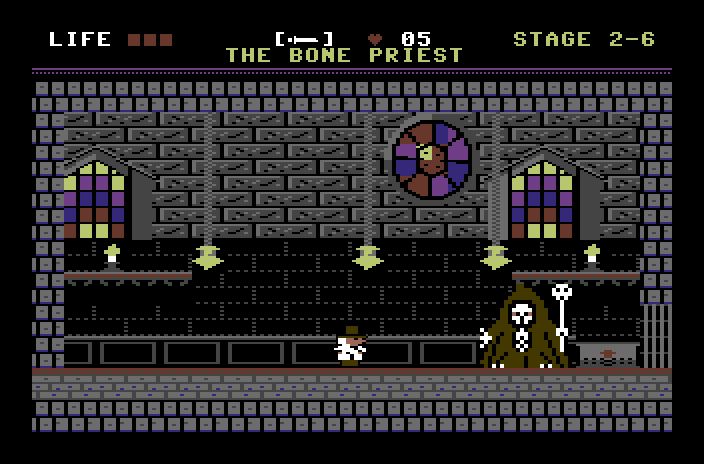
Van Helsing: A Night at Castle Dracula is a gothic puzzle-platformer for the PAL Commodore 64, after Bram Stoker’s Dracula. This is the story from the back of the box:
Midnight. Professor Van Helsing has come to Castle Dracula with a whip in his hand. Before dawn he must cross the whole castle, one hour at a time: the graveyard, the chapel, the crypts, the library, the clock tower and the keep. Every room is a puzzle, and every chapter ends with something waiting for him.
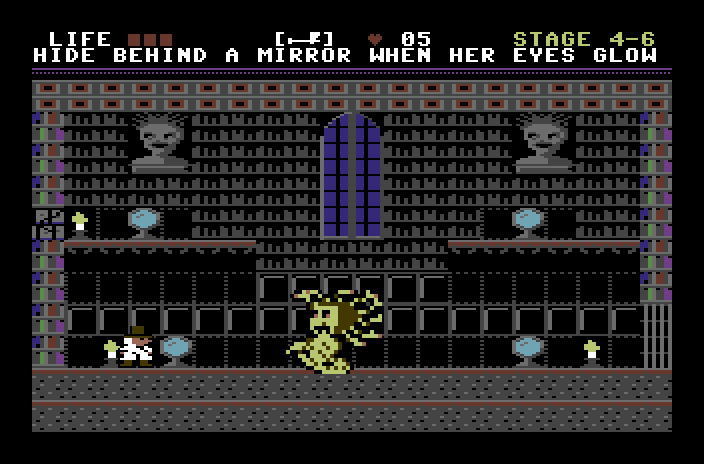
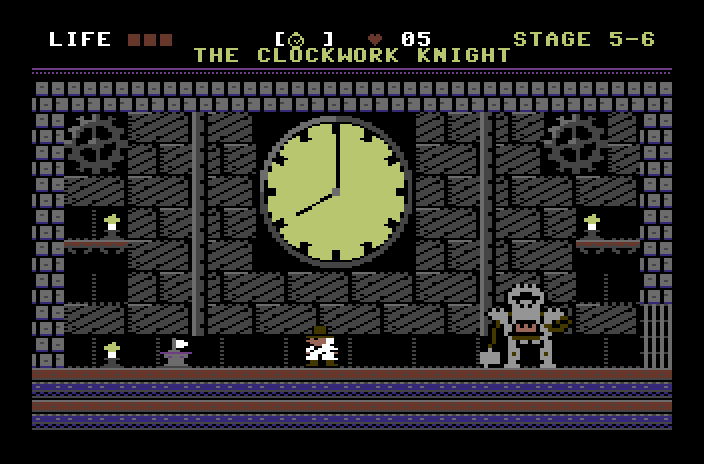
There are 36 rooms in six chapters, one for each hour of the night from midnight to five o’clock. There are six bosses: the great wolf, the Bone Priest, the Pale Bride, the Gorgon, the Clockwork Knight and Count Dracula. His weapons are a whip, plus a dagger, holy water, a cross, an axe and a stopwatch to find. Inspired by Castlevania? Hmmm, maybe a little.
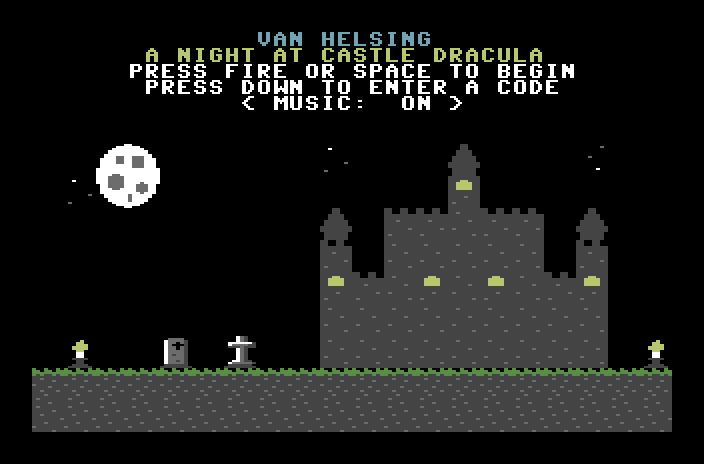
The music is arranged after Bach, Beethoven, Chopin, Grieg, Holst, Saint-Saëns, Schubert and Tchaikovsky. You don’t need a manual to play: the game shows you what to do, on the line under the status bar, as each new thing comes up.
There are disk, tape and EasyFlash cartridge versions, with an illustrated manual, a cassette inlay and box art. You can download the game and the manual from itch.io. It is a PAL game: on an NTSC Commodore 64 it runs about 20% faster. Should I make an NTSC version? Let me know what you think.
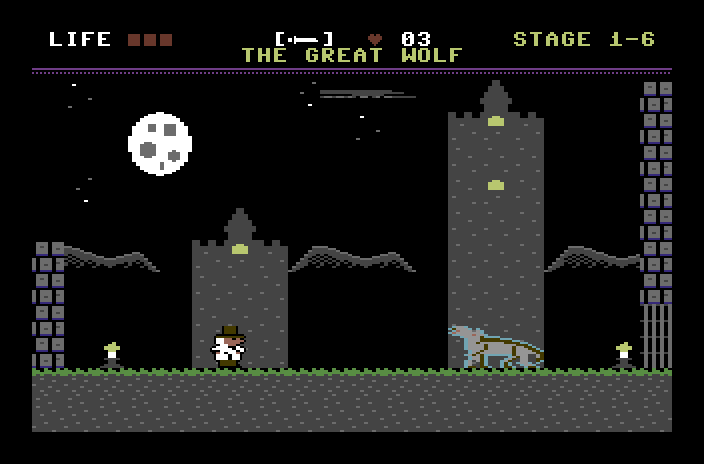
How I made it
The tools
I used Claude, Anthropic’s AI, in Claude Code inside VS Code. The game is written in 6502 assembly with Kick Assembler, and I tested it in the VICE emulator and on my own Commodore 64C. I have tested it on a real 1541 disk drive.
The cover paintings came from Leonardo.ai, using the Nano Banana 2.1 model. I would love to get someone to do a real cover for the game. I am no artist, but I can see that a hand-drawn cover would add a lot. A script that Claude wrote laid out the box, the inlay and their lettering. The image model kept garbling the word SOFTWARE (once it painted “SOFTMARE”), so the lettering is drawn by the script, not painted.
Who did what
I set the plot, the rules, the look and the feel. I chose between the options at every step, played the builds in VICE and on my C64C, and decided every change. I also added parts of the code myself, things I have written over the years, such as the main character’s movement.
Claude wrote most of the 6502 code and drew the sprites and backdrops to my direction. I drew some of the sprites badly and got Claude to keep working on versions until I was happy. Claude arranged the music, wrote the tests and the test players, and drafted the manual. All of this was described in detail. I wanted Claude to use my techniques to create the game I wanted.
My design rules for every room
- It can always be solved.
- There’s no farming.
- The game never says what to do without showing how.
- There’s one way to die: spikes, water and falls cost a point and put you back on firm ground.
- The music is slow, sinister and public domain.
How it was tested
- 68 versions in the changelog, from 0.1.0 on 6 October 2026 to 1.1.0 on 19 October 2026.
- 21 automated test suites with 1,475 checks, run after every change. They run the game’s real machine code in a simulated 6502, and check the rooms, prompts, enemies, music, memory and timing.
- Test players (“bots”) play the rooms and the boss fights: a careful player, a hasty one and a careless one. Each is given a person’s reaction time: 12 frames (about a quarter of a second) for the careful player, and 20 frames (about 0.4 seconds, with a little random timing) for a “typical” player. The rule is that the careful player must win unhurt, the careless one must pay, and the typical player must get through. The bosses are tuned against measured curves, not guesses.
- Every busy moment must fit in one PAL frame of 19,656 cycles. The busiest frame in Dracula’s chamber takes 13,038.
- At version 0.26.0, a team of seven AI reviewer agents went through the whole game, and their findings were fixed.
What play-testing changed
Playing the builds myself, in VICE and on my C64C, led to changes like these.
The Pale Bride
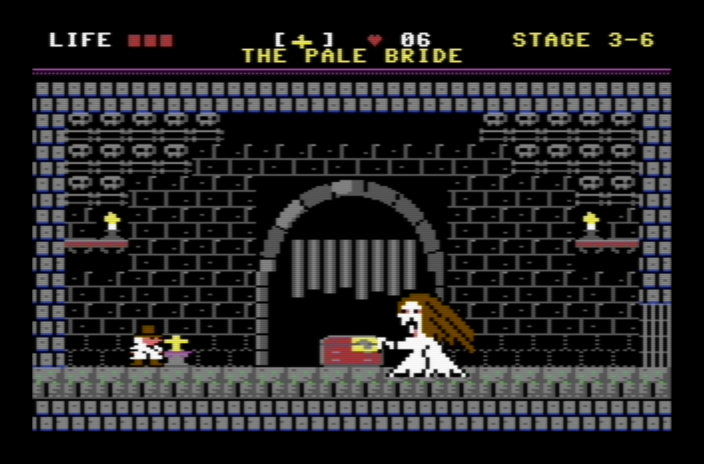
My complaint about the Pale Bride was that “all you have to do is throw crosses at the boss and the bats without moving, there is no danger.” So now she keeps out of the cross’s reach and sweeps in at you. Her bats hang over you, flashing, then drop where you stood.
That was too hard for that stage of the game, so the test players measured the bats’ warning time:
- at 24 frames, a typical player dies;
- at 32, they only just get clear;
- at 36 (0.7 seconds), they get through unhurt.
It’s now 36.
There are techniques to win every level, and clues to help you, both in the animations and written at the top of the screen.
The music on real hardware
On my C64C, the music dropped out whenever a sound effect stole the melody’s voice. Sound effects now borrow whichever voice is resting. This was a technique that did not occur to me. I assumed that if you had music and sound effects, you could only use two voices for the music and one for the effects. Claude came up with the trick of “borrowing”.
Dracula’s finale
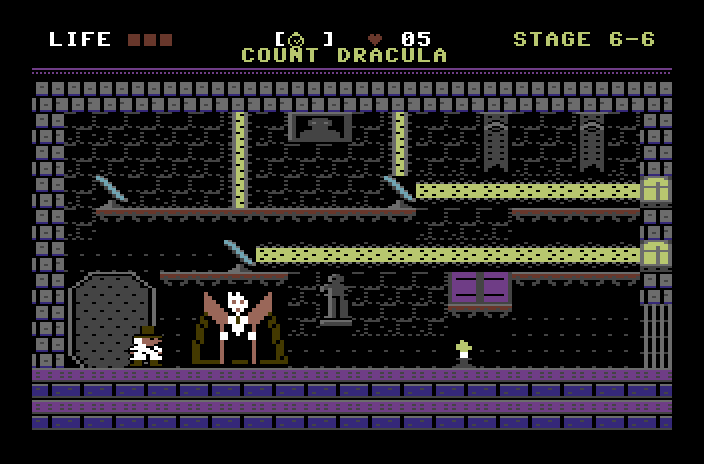
My verdict on Dracula’s fight was: “You only have to hit him with light twice … over and done with in about 5 seconds.” So it became a fight in three acts. It now takes about a minute or so to beat the final boss, but it could take much longer than that, depending on how well you do.
The timing of the bats spawning is key to how challenging the level is. You cannot make a lot of progress before you have to deal with a bat. It’s all about timing and risk and reward.
Technical touches
- Chapters load from disk as you reach them, with music playing while they load. That needed a custom loader, because the C64’s own LOAD routine stalls the interrupts that the music runs on.
- There’s an EasyFlash cartridge build.
- The tape version tells you when to rewind.
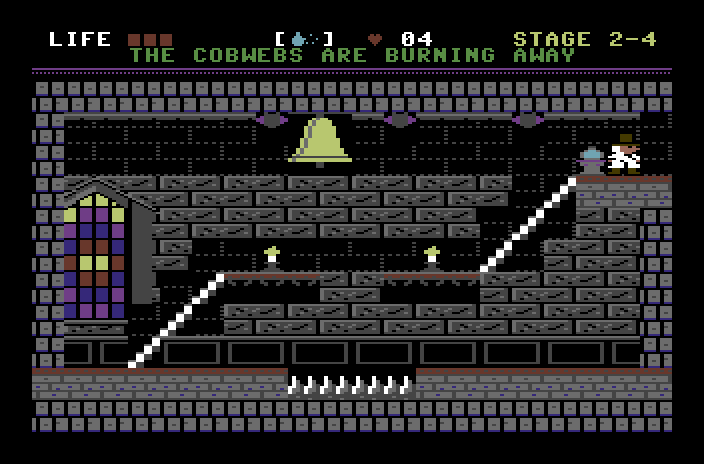
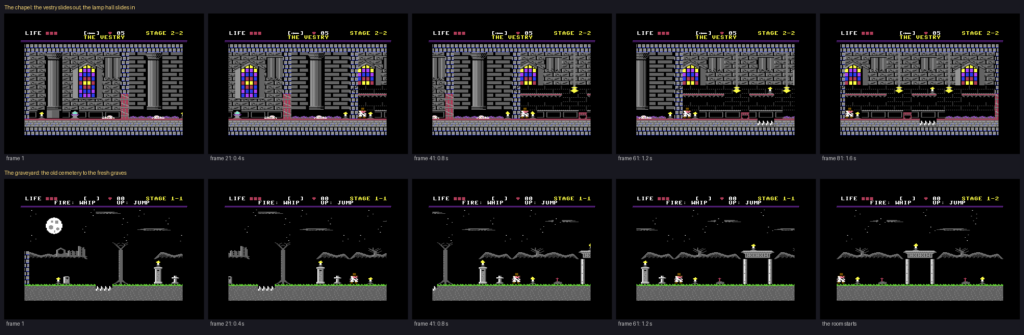
- Rooms turn like pages, in a 1.6-second slide. I originally wanted each chapter to scroll from start to finish. That was too tough a challenge for the C64’s memory. A version with memory expansion could do it easily, though. Possibly a sequel?
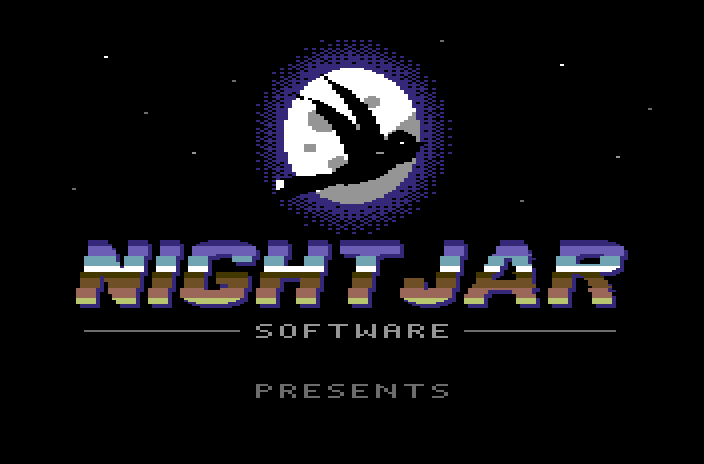
- There’s a loading picture, and the Nightjar ident plays before it.
Update: a turbo loader for the tape (version 1.1.0)
The tape version now loads the way 80s games did, with its own turbo loader:
- Hold SHIFT and press RUN/STOP, then press PLAY. The C64 finds VAN HELSING and loads a small starter program in about 25 seconds.
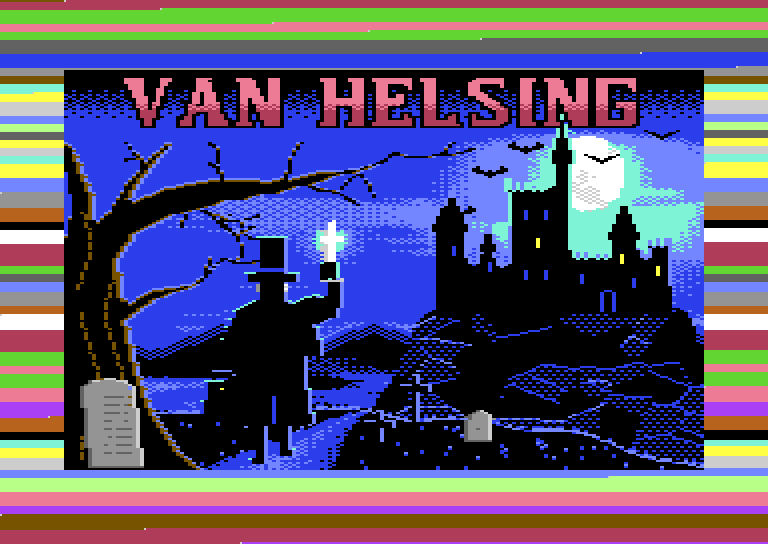
- The whole screen fills with flashing coloured stripes while the loading picture comes in.
- The Nightjar Software ident and the loading picture appear, with music. The border flashes while the game loads behind the picture.
That’s about two minutes in all, where the C64’s own tape loader took seven. Each chapter then loads in 20 to 30 seconds instead of 2 to 3½ minutes. The game itself is unchanged, and so are the disk and cartridge versions.
So, can you make a good C64 game with AI?
My answer is that AI let me do what I would have done by hand, only much faster. That speed is what made the game possible at all. Whether the result is a good game is partly for you to judge.
What next? Tell me what you think
I’ve had another game in my head for a long time: a Command & Conquer-style real-time strategy game with a different theme. I have already created a large play area that scrolls in all directions. It would be even more challenging, and would probably take many months, even with AI. If I do it, I would want to push way beyond what we thought was possible years ago, and I can only do that because of AI.
So I’d like your answers to three questions:
- Should I do it?
- Will people play a game they know was made with the help of AI?
- Will everyone be tarred with the same brush? Someone who vibe-codes a random game in an hour gets the same label as someone who meticulously builds a complex, well-structured game through weeks of testing and perfecting.
Play Van Helsing in the C64 emulator, then tell me what you think. There’s more on old computers and on AI in the Retro and AI Tools sections.